TRENDING
NASA’s Griffin-1 Completes Testing Ahead of Moon Mission
Griffin-1 passes a series of rigorous tests at JPL, preparing for a historic lunar delivery later this year.
Event · Published · 2 min read
Video report
Media: © OpenStreetMap contributors · OpenFreeMap · Photo: NASA / JPL-Caltech · Robert Andreoli · NASA JPL · David Ladd, Tom Waters, Ernie Wright · Genna Duberstein, Gary Davis, Troy Cline, Michael McClare, Barbara Lambert, Jessica McCarthy · NASA/JPL-Caltech
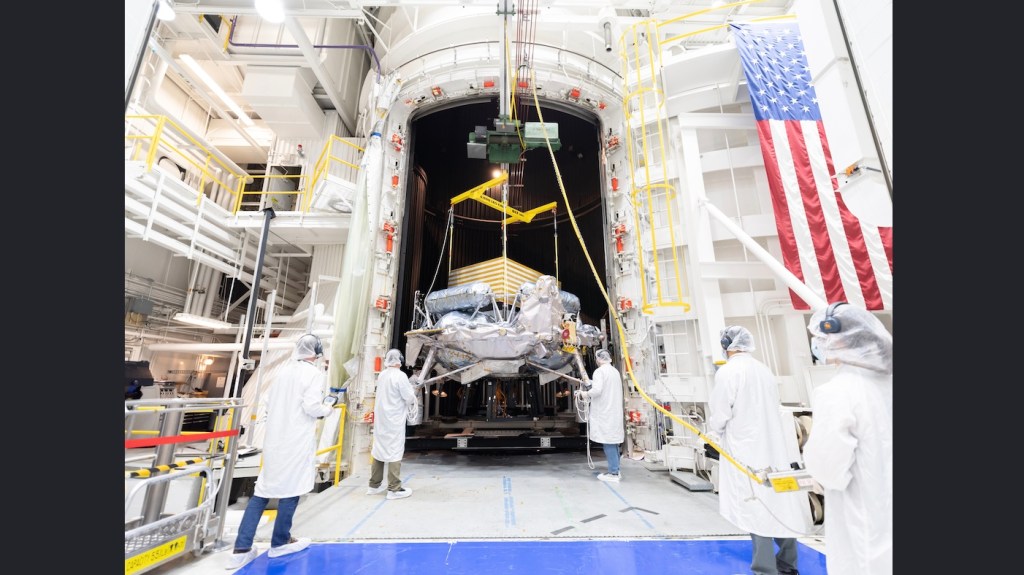
The Griffin-1 spacecraft, developed by Voyager Technologies, has successfully completed a series of rigorous environmental tests at NASA's Jet Propulsion Laboratory (JPL) in Southern California. These tests are a crucial step in preparing the lander for its upcoming mission to the Moon, where it will play a significant role in NASA's efforts to establish a lunar base.
The testing, which began in July and concluded in late September 2026, involved simulating the extreme conditions Griffin-1 will face during its journey and operations on the lunar surface. The spacecraft was subjected to temperatures ranging from 167 degrees Fahrenheit (75 degrees Celsius) to minus 148 degrees Fahrenheit (minus 100 degrees Celsius) in JPL's 25-Foot Space Simulator, a thermal vacuum chamber listed on the National Register of Historic Places. This chamber has been instrumental in testing historic missions since the 1960s.
Engineers also conducted electromagnetic interference and compatibility testing in an anechoic chamber, where long foam spikes absorb sound and electromagnetic waves. This ensures that the spacecraft's electronic components do not interfere with one another during the mission. Additionally, Griffin-1 underwent vibration testing on a 'shaker table' to simulate the intense forces of launch, monitored by hundreds of sensors.
Griffin-1 is part of NASA's Commercial Lunar Payload Services (CLPS) initiative, which aims to support the establishment of a Moon Base. The spacecraft is expected to launch later this year aboard a SpaceX Falcon Heavy rocket. It will deliver over 1,100 pounds (455 kilograms) of cargo to Nobile Crater near the lunar South Pole, including 10 science and technology demonstrations from six countries. Among these is Astrolab's FLIP (FLEX Lunar Innovation Platform) rover, marking the largest commercial payload ever delivered to the Moon.
Following the successful completion of these tests, Griffin-1 has returned to Voyager Lunar Systems' facility in Pittsburgh for final assembly. The spacecraft will undergo launch-readiness operations before being shipped to Cape Canaveral for its anticipated launch.
Charles Whetsel, manager of the Exploration Systems Development Office at JPL, expressed pride in the testing facilities' role in supporting this new phase of commercial lunar exploration. "NASA JPL’s Environmental Test Laboratory has been putting robotic explorers to the test since the Ranger program gave us NASA’s first up-close views of the Moon’s surface in the mid-1960s," Whetsel said.
John Thornton, executive vice president of Voyager, highlighted the significance of Griffin-1's mission, stating, "This spacecraft represents a new era of commercial lunar exploration, where missions like Griffin-1 are laying the groundwork for the Moon Base and helping turn sustained lunar exploration from a vision into a reality."
Sources (3)
TradepilotUSA News writes each story in its own words from the independent reports listed above and links to them. How we report · Report a correction